


Introduction: The New Frontier of Food Security
For generations, agriculture relied on a fundamental expectation: predictability. Farmers looked to historical weather cycles, reliable seasonal shifts, and established soil trends to plan their planting, irrigation, and harvesting schedules. Today, that predictability has vanished. Extreme weather events, prolonged droughts, sudden pest migrations, and unseasonal temperatures are rewriting the rules of global food production. At the same time, the global population is projected to reach nearly 10 billion by 2050, requiring a 60% increase in food production on a planet with shrinking arable land and depleted water reserves.
Feeding the future under these conditions requires more than incremental improvements; it demands a systematic paradigm shift. This is where the convergence of Artificial Intelligence (AI) and smart robotics is stepping in. By turning real-time field data into precise, autonomous physical actions, these technologies are moving agriculture away from blanket, reactive applications toward hyper-targeted, predictive management. This transition to climate-resilient agriculture is not merely an environmental imperative—it is the ultimate business-value strategy for modern agribusinesses looking to secure their yields, optimize resource efficiency, and protect their margins.
1. Market and Field Realities: The Triad of Climate, Labor, and Resource Scarcity
To understand why AI and robotics are scaling so rapidly, one must look at the compounding pressures currently squeezing farm balance sheets globally. Growers today are navigating three distinct but deeply interconnected crises: extreme climate volatility, chronic labor shortages, and skyrocketing resource costs.
Climate Volatility and Yield Uncertainty
Drier summers and unpredictable monsoons are disrupting plant physiology, leading to unexpected yield drops. Soil degradation, caused by decades of intensive farming and compounded by high heat, has reduced the natural water-retention capacity of the earth. When rain does fall, it often comes in torrential bursts that wash away topsoil and nutrients rather than nourishing the crop roots.
The Agricultural Labor Deficit
The human element of farming is under unprecedented stress. Globally, the agricultural workforce is aging, and younger generations are migrating to urban centers. Agribusinesses face severe seasonal labor shortages, leaving high-value crops to rot in the fields. Where labor is available, wages are rising, and safety regulations around working in extreme heat are rightfully tightening, reducing the window of time workers can safely spend in the fields.
Input Inflation and Environmental Degradation
Traditional “broadcast” farming—spraying entire fields uniformally with water, fertilizers, and crop protection chemicals—is no longer economically or environmentally viable. The cost of synthetic fertilizers and chemical inputs has surged due to geopolitical tensions and supply chain vulnerabilities. Simultaneously, overuse of these chemicals has led to widespread runoff, polluting local watersheds and triggering strict regulatory penalties. Farmers find themselves caught in a vice: they must produce more, with less water and fewer chemicals, while using a smaller, more expensive workforce.
“The modern grower is no longer just a manager of land; they are a manager of extreme risk. Every input must be justified, and every seed must count.”
2. Technology and Innovation: The Digital Architecture of Climate Resilience
The response to these field realities is a suite of advanced technologies that combine digital intelligence with physical execution. This is not about replacing the farmer’s intuition; it is about scaling that intuition across thousands of acres, plant by plant, in real time.
Computer Vision and Real-Time Agronomic Insights
At the heart of agricultural AI is computer vision. High-resolution cameras mounted on tractors, drones, or autonomous field robots capture detailed imagery of the crop canopy and soil. Deep learning models, trained on millions of agricultural images, analyze these feeds on the fly. Within milliseconds, an AI system can distinguish between a cash crop and a newly emerged weed, detect the early signs of fungal rust before it is visible to the human eye, or count fruit blossoms to predict seasonal yields.
Autonomous Robotics and Precision Intervention
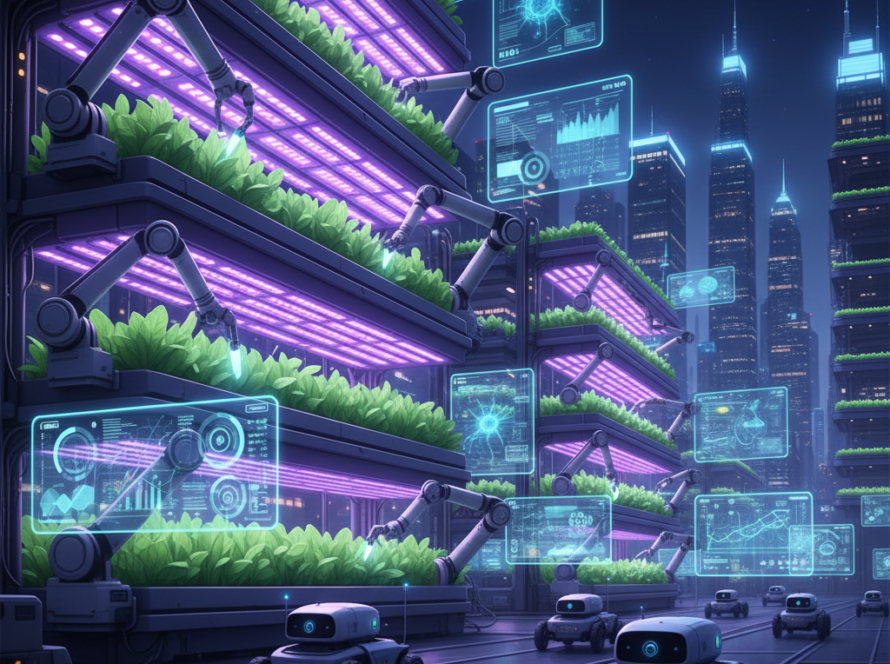
Where AI acts as the brain, smart robotics serve as the hands. Traditional tractors are being joined—and in some cases replaced—by lightweight, autonomous field units. These robots use GPS, LiDAR, and ultra-wideband sensors to navigate fields without compacting the soil, operating day or night.
Instead of spraying an entire crop with herbicide, a smart robot uses micro-nozzles to apply a single drop of chemical directly onto the leaf of a weed, reducing herbicide use by up to 90%. Other platforms use high-energy lasers or mechanical micro-hoes to eliminate weeds without a single drop of chemical, preserving soil biology and keeping farms compliant with tightening chemical regulations.
- Targeted Pest Control: Micro-dosing systems that apply insecticides only to infected plants, reducing chemical drift and saving on input costs.
- Dynamic Irrigation: Automated drip networks connected to AI hubs that adjust water flow based on localized soil moisture sensors, weather forecasts, and transpiration rates.
- Selective Harvesting: Robotic harvesters equipped with soft-touch grippers and spectral sensors that pick only fruits and vegetables that have reached perfect ripeness, returning to the field daily to harvest the rest.
3. Illustrative Scenarios: Innovations in Action
To see how these technologies translate to the real world, let us look at two distinct, region-neutral scenarios where AI and robotics successfully stabilized farming operations.
Scenario A: De-risking Specialty Orchard Production
A mid-sized apple orchard operation faced severe seasonal labor shortages and unpredictable spring frosts. By deploying a fleet of autonomous, low-altitude scouting drones paired with ground-based robotic weeders, the grower transformed their management approach.
The drones, using thermal imaging, identified micro-climates across the orchard, allowing the grower to deploy targeted frost-prevention measures exactly where they were needed, saving energy and water. Later in the season, the ground robots handled under-canopy weeding without human supervision. When harvest arrived, predictive AI models analyzed the blossom-to-fruit transition rate, allowing the operator to hire exactly the right number of seasonal workers and secure logistics contracts well in advance, avoiding costly last-minute spot rates.
Scenario B: Regenerative Grain Farming at Scale
A large-scale grain farm struggled with soil erosion and rising fertilizer costs. The farm integrated AI-enabled smart seeders onto their existing tractor fleet. As the machinery moved across the field, on-board soil sensors analyzed organic matter and moisture levels in real time, dynamically adjusting the depth and spacing of seeds, alongside a customized blend of liquid fertilizer applied directly to the seed furrow.
By placing the precise amount of nutrient exactly where the seed could access it, the farm cut fertilizer consumption by 30%, improved crop emergence rates by 15%, and significantly reduced nutrient leaching into adjacent water ways, proving that sustainability and profitability can go hand-in-hand.
4. Business Models and Agri-Finance: Funding the Transition
One of the biggest hurdles to scaling climate-resilient technology is the upfront capital expenditure (CapEx). Buying cutting-edge robotic machinery or installing comprehensive sensor networks is a major financial lift, especially for family farms operating on thin margins. Fortunately, the business models supporting agri-tech are evolving rapidly.
Robotics-as-a-Service (RaaS)
To bypass the high cost of ownership, many equipment companies and startups are offering Robotics-as-a-Service (RaaS). Instead of buying a $150,000 weeding robot, farmers pay a service provider on a per-acre or per-hour basis. The provider brings the robot to the farm, manages the operation, and takes it away when the job is done. This turns a high capital expense into a manageable operational expense (OpEx), instantly lowering the barrier of entry for mid-sized operations.
The Rise of Green Agri-Finance
Institutional lenders, venture capital funds, and agricultural banks are increasingly tying loan terms to sustainability metrics. Farmers who can prove they use precision tools to reduce chemical runoff, conserve water, or sequester carbon in the soil are gaining access to preferred interest rates and green bonds. AI platforms that generate clean, verifiable data sheets on input reduction are becoming crucial tools for farmers seeking to qualify for these financial incentives.
This intersection of technology, finance, and practical field scaling is precisely why platforms like the AgriNext Awards & Conference – USA are so crucial for the industry. Taking place on 9 April 2027 at the JW Marriott Las Vegas Resort & Spa in Las Vegas, USA, this premier global event, organized by Next Business Media, brings together agri-tech innovators, investors, and agribusiness leaders to examine the future of crop production. It is an ideal space to explore emerging financial structures, see the latest in precision farming and digital robotics, and discuss practical scaling strategies.
For organizations looking to lead this shift, there are numerous ways to engage. You can learn more about the event’s agenda, register as a delegate to network with global decision-makers, apply for awards that honor excellence in agri-tech and sustainable farming, become a sponsor or exhibitor to showcase your solutions, or submit your speaking proposal to share your insights on the main stage.
5. Policy, Regulation, and the ESG Imperative
The transition toward tech-enabled resilience is also being accelerated by regulatory frameworks worldwide. Governments are shifting from voluntary environmental guidelines to mandatory compliance structures.
Chemical and Nitrogen Restraints
From Europe’s Farm to Fork strategy to local watershed protections in North and South America, strict ceilings are being placed on nitrogen applications and synthetic pesticide volumes. AI-driven precision spraying is the most direct pathway for large agribusinesses to remain compliant without sacrificing their yield capacity.
Data Sovereignty and Standards
As farms become highly digitized, a new regulatory challenge has emerged: agricultural data governance. Farmers are rightfully protective of their yield, soil, and operational data. Policymakers are working to establish standards that ensure interoperability between different machinery brands while safeguarding the farmer’s data ownership rights. Open-source data communication protocols (like ISOBUS standardizations) are paving the way for seamless integration between legacy farm machinery and novel AI software suites.
Strategic Recommendations for the Agri-Food Ecosystem
To successfully navigate and capitalize on this digital agricultural revolution, different stakeholders across the value chain must take proactive, deliberate steps:
- For Agribusinesses and Farm Managers: Focus on interoperability. When investing in new smart tools, prioritize platforms that can easily share data with your existing machinery, ERP systems, and agronomic software to avoid creating isolated silos of information.
- For Technology Developers and Startups: Focus on solving “unsexy” but critical pain points. Rather than building generic data dashboards that overwhelm users, build targeted, reliable physical solutions that solve labor shortages or reduce input costs on day one.
- For Investors and Venture Builders: Look for hybrid business models like RaaS that ease the grower’s financial risk, and pay close attention to platforms that collect audit-ready ESG and resource-use data, which will dominate future agricultural finance.
- For Government and Extension Officers: Facilitate local testing hubs. Establish regional demonstration farms where local growers can see AI and robotic systems operating in their specific soil and climatic conditions before committing to adoption.
Conclusion: The Digital Horizon of Global Food Systems
The integration of artificial intelligence and smart robotics is transforming global agriculture from a sector defined by unpredictability into one characterized by precision, speed, and resilience. By treating every plant as an individual, rather than managing fields as uniform entities, growers are finding a way to decouple productivity from resource depletion. As climate challenges intensify, those who embrace these digital tools will not only protect their bottom lines but also play a direct role in securing the global food supply. The future of farming is no longer on the horizon; it is already working in the soil, paving the way for a more stable, productive, and resilient food system.
 Reach us on WhatsApp